


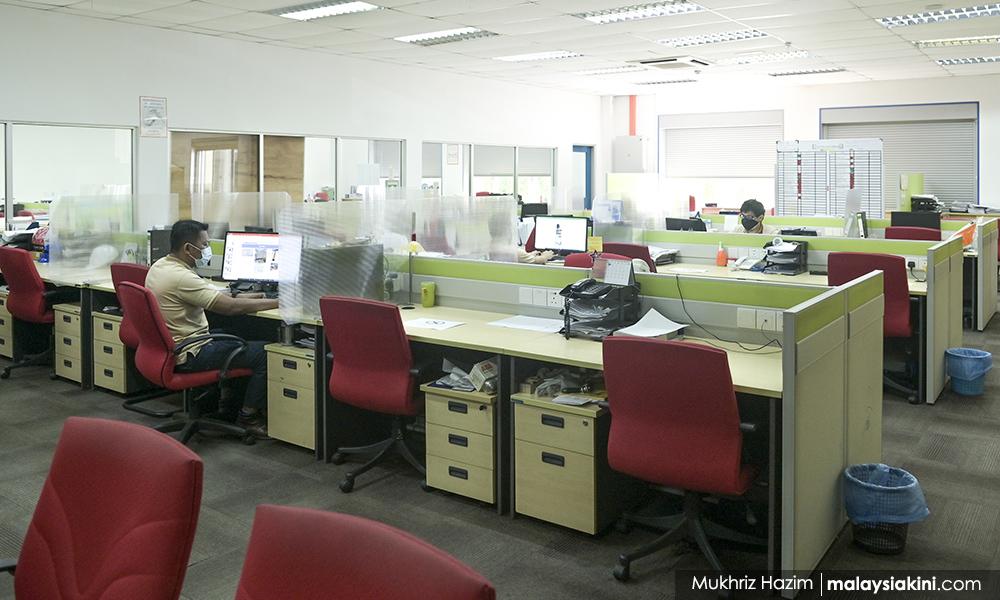

How to ventilate your home, office, factories to lower Covid-19 risks
The Health Ministry and Human Resources Ministry have released long-awaited guidelines on how to improve ventilation in homes, offices, and businesses such as factories to lower the risk of Covid-19 transmission.
Malaysiakini breaks down those guidelines.
General advice
The guidelines are split into four documents, but there are some common guidelines among all four.
The first is that putting in place portable air cleaners should not be the only measure to improve indoor air quality.
For air-conditioned locations without centralised mechanical ventilation (MVAC), doors and windows should be opened as frequently as possible to let fresh air in.
The recommended air conditioning temperature range is between 23 degrees to 26 degrees Celcius with relative humidity between 40 and 70 percent.
Stand fans can be used to blow air out of windows and doors or to blow fresh air in.
If using fans to increase ventilation, do not direct airflow directly from one person to another, as this can increase the risk of possible airborne transmission of the virus.
If using exhaust fans - such as in toilets - do not open windows directly next to it to avoid short-circuiting airflow.
Guidelines for homes
As per the general advice the guidelines do not recommend overreliance on home air conditioning.
"This may give a false sense of freshness as they do not have ventilation provisions and their filtration systems are inadequate to filter or inactivate airborne virus particles," the guidelines stated.
It said when air conditioners are not in use that as many windows and doors should be opened to ventilate your home, especially in the morning and evening when outdoor air is cooler.
Small openings in windows while the air conditioning is on, is also recommended to improve ventilation.
The guidelines recommended installing mesh screens if mosquitoes and other insects are a concern.
While fresh air was highly recommended, the guidelines, however, cautioned those living in flats, apartments, and condominiums against opening windows that face neighbouring homes frequently unless necessary - such as to keep a room cool.
It also advised against using balconies that are in close proximity of neighbouring homes.
Home isolation spaces
Meanwhile, the guidelines also contained advice for creating isolation spaces for family members who are sick, suspected or have been infected by Covid-19.
In this situation, air conditioning should not be used in isolation rooms and windows should be opened for natural ventilation.
If using a shared bathroom, it is important to ensure good ventilation by either opening a window or using exhaust fans.
Do not open windows adjacent to a running exhaust fan to avoid short-circuiting airflow.
Toilet exhaust fans - if any - in the isolation space should be run continuously to lower the potential of aerosols escaping into the main living area.
Non-residential spaces without MVAC
For air-conditioned non-residential spaces without MVAC, such as some smaller offices or businesses, the guidelines recommend turning off the air-conditioning when windows or doors are open.
It said exhaust fans in places like toilets or kitchens...




Report this comment
Are you sure you want to delete this comment?
This action cannot be undone.